


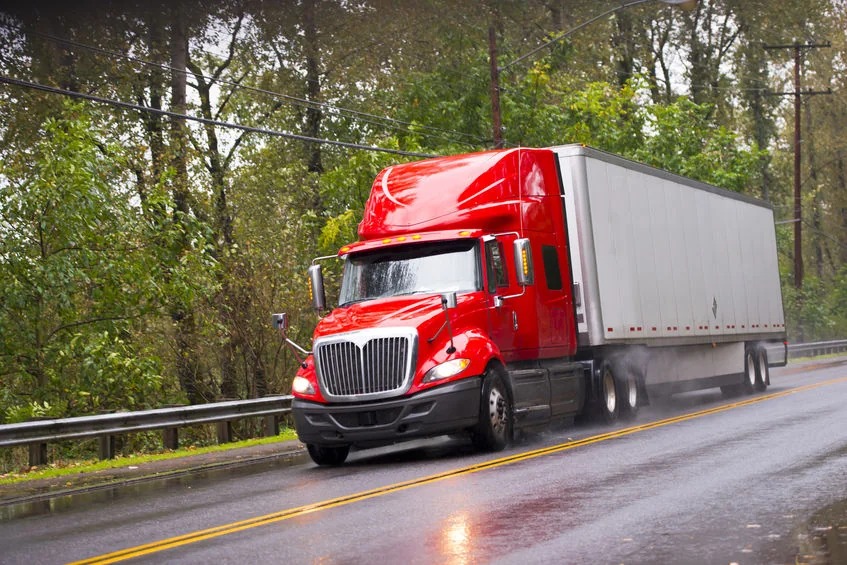
Stock photograph illustrating wet-road conditions; not a photograph of a jackknife crash.
What is a jackknife truck accident? It is a loss-of-control event in which a tractor and its trailer fold toward each other at their connection, rather than continuing along a controlled path. The growing tractor-trailer angle can carry the trailer across neighboring lanes and into other vehicles. The name describes the folding movement, which resembles a closing pocketknife.
For someone injured in Georgia, the important questions are what started that movement, whether anyone could reasonably have prevented it, and what evidence still exists. Hard braking, poor traction, equipment problems, and another vehicle’s actions can require very different investigations. A jackknifed truck does not, by itself, prove that its driver was negligent.
Key Takeaways
- A jackknife involves uncontrolled movement between the tractor and trailer. A normal tight turn or backing maneuver is different.
- Investigators should distinguish a tractor drive-wheel skid from a trailer skid and establish when each movement occurred.
- Weather, speed, braking, tires, loading, and vehicle maintenance can interact. No single photograph identifies the cause.
- Preserve both vehicles, available electronic records, video, inspection documents, and roadway evidence promptly.
- Georgia fault rules can reduce or bar an injured person’s recovery depending on their share of responsibility.
How a Tractor-Trailer Jackknife Happens
A tractor and semitrailer must pivot relative to each other to negotiate a curve. A jackknife occurs when that movement becomes uncontrolled. There is no need to assume that the combination must reach a precise 90-degree angle before the event matters.
The NHTSA 2021 FARS/CRSS Coding and Validation Manual treats jackknifing as uncontrolled articulation while the combination is moving. It also cautions that the final resting position alone does not establish that a jackknife occurred. Investigators need the sequence before, during, and after impact.
Two mechanisms deserve separate attention:
- Tractor jackknife: Loss of traction at the tractor’s drive wheels can let the trailer push the tractor sideways.
- Trailer swing: A trailer’s wheels can skid and the trailer can swing away from its intended path behind the tractor.
The Georgia DDS Commercial Driver’s Manual, Sections 2.19 and 6.1, explains these skid mechanisms and warns that an empty or lightly loaded combination can still be difficult to control. An empty trailer is not automatically a safer trailer.
A jackknife may precede a collision, develop after an initial impact, or occur alongside a rollover. It is also different from a truck underride accident, in which a smaller vehicle travels beneath part of a truck or trailer. A reconstruction should identify each event instead of treating these terms as interchangeable.
Jackknife Accident Causes: What the Evidence Must Show
The following matrix connects possible causes with useful evidence. These are investigative questions, not findings about any particular crash. A suspected condition must be connected to the actual loss of control and resulting injuries.
| Possible contributing factor | Evidence to preserve | Question to test |
|---|---|---|
| Late or excessive braking | Available speed and brake-event data, dashcam footage, following distance, traffic sequence, and tire marks | Was the braking response unreasonable for the developing hazard, or was it a reasonable response to an emergency? |
| Brake imbalance or malfunction | Tractor and trailer brake components, adjustment measurements, air-system inspection, fault codes, and repair history | Did unequal or defective braking contribute before impact, rather than result from collision damage? |
| Reduced road traction | Time-specific weather, pavement photographs, drainage conditions, tire condition, and vehicle paths | What traction was available, and was speed appropriate for those conditions? |
| Curve speed or abrupt steering | Curve geometry, video, available steering or stability-system data, tire marks, and reconstructed movement | Did the vehicle enter the maneuver within the traction available? |
| Load or weight-distribution issues | Loading photographs, bills of lading, scale tickets, securement equipment, and cargo position | Did the pre-crash load contribute to instability, or did cargo move because of the crash? |
| Another vehicle’s actions | Surrounding vehicles’ video, independent witnesses, damage patterns, and lane-position evidence | Did a cut-in, impact, or blocked path trigger the event, and how did the truck driver respond? |
Technical sources informing this matrix include the Georgia DDS manual linked above, the technical paper “The Anatomy of a Tractor Trailer Jackknife,” preserved in an NTSB investigation docket, and the federal weather and maintenance rules discussed below. The matrix does not rank causes by frequency or represent Georgia crash statistics.
Braking, traction, and brake imbalance
A truck braking accident is not necessarily evidence of careless braking. An expert may need to distinguish excessive brake demand, a mechanical problem, and an unavoidable need to slow down. The technical paper in the NTSB docket discusses how drive-wheel lockup, wheel spin, and excessive curve speed can lead to jackknifing. It also identifies brake imbalance as an equipment issue that warrants investigation.
That makes inspection of both the tractor and trailer important. A tractor-only inspection can miss trailer equipment relevant to the sequence. A damaged brake part, standing alone, cannot establish whether the part failed before the crash or broke during it.
Weather conditions and speed
Rain or ice may help explain a loss of traction, but weather does not resolve fault. For commercial operations covered by 49 C.F.R. § 392.14, drivers must exercise extreme caution when hazardous conditions impair visibility or traction, reduce speed, and discontinue operation when conditions become sufficiently dangerous.
The investigation should compare the truck’s speed with the conditions at that location and time. A posted speed limit does not answer whether a particular speed was reasonable on a wet curve. Nearby weather reports also should be checked against scene photographs and witnesses rather than treated as a perfect record of pavement conditions.
Electronic stability control and maintenance
Antilock braking systems and electronic stability control perform different functions. CVSA’s ABS guidance explains that ABS modulates braking to help prevent wheel lock and preserve control. NHTSA’s heavy-vehicle ESC rule describes computer-controlled braking and engine-torque reduction intended to mitigate roll instability and severe understeer or oversteer.
Neither system’s presence proves that a crash was preventable. Investigators should identify the vehicle’s equipment, applicable manufacturing requirements, warning history, and actual system condition. Do not assume every truck has the same technology or preserves the same electronic information.
For covered carriers, 49 C.F.R. § 396.3 requires systematic inspection, repair, and maintenance of vehicles under their control. Relevant records may show repeated brake or tire complaints, completed repairs, or gaps requiring further explanation. A maintenance violation must still be connected to the collision to support a causation theory.
Who Is at Fault in a Jackknife Truck Accident in Georgia?
Fault depends on conduct and causation, not the crash label. Potentially responsible parties can include:
- The truck driver: If unreasonable speed, following distance, braking, steering, or another driving decision contributed to the crash.
- The motor carrier: Depending on the employment relationship and work being performed, the carrier may face responsibility for its driver’s conduct. Its own maintenance, training, or operational decisions may also require investigation.
- A maintenance provider or equipment manufacturer: If evidence connects faulty work or a defective component to the loss of control. A malfunction does not automatically identify which business is responsible.
- A shipper or loader: If a proven loading or securement problem contributed and the party had responsibility for that work.
- Another motorist: If an unsafe maneuver or collision contributed to the emergency or subsequent impacts.
Several parties may share responsibility. Their contracts, actual roles, and the event sequence matter; the company name on a trailer is only a starting point for identifying them.
Under O.C.G.A. § 51-12-33, an injured plaintiff’s damages are reduced in proportion to their fault, and a plaintiff who is 50% or more responsible cannot recover damages. For example, if total damages are $100,000 and the plaintiff is assigned 20% fault, the fault reduction leaves $80,000 before other applicable adjustments. This is an arithmetic illustration, not a settlement estimate.
An insurer’s initial statement that a passenger vehicle “caused the truck to brake” is not the end of the analysis. Investigators must evaluate the entire approach: spacing, visibility, available response time, equipment condition, and each vehicle’s movement.
What Evidence Proves Negligent Braking in a Truck Crash?
There is rarely one record that proves everything. A reliable braking analysis combines physical findings with a synchronized timeline. After a serious jackknife truck crash, priorities include:
- The tractor, trailer, and relevant components. Identify their storage locations and seek preservation before repairs, salvage, or disposal. Qualified inspectors should document condition and arrange appropriate examinations.
- Available electronic information. Seek engine-control module records, braking or stability-system information, telematics, and dashcam files where available. Different devices record different fields and events; none should be assumed to contain a complete second-by-second account.
- Original video and witness information. Preserve files from involved vehicles, nearby businesses, and other identified sources. Keep originals with timestamps and metadata, rather than relying only on edited clips or screenshots.
- Roadway and vehicle-path evidence. Document lanes, curves, grades, tire marks, debris, impact locations, and final positions. Record when photographs were taken because traffic, weather, and cleanup can change the scene.
- Operational and maintenance records. Request relevant inspection reports, brake repairs, tire records, driver complaints, dispatch communications, load documents, and duty-status records. An electronic logging device primarily records duty status; it is not a substitute for crash-event data.
For a closer look at electronic records, see our guide to truck accident black box data. The useful question is which device captured which information on this particular truck.
Preservation should begin promptly because devices and video systems can overwrite information. A lawyer can direct preservation requests to the carrier and other identified custodians, request coordinated inspections, and use appropriate legal procedures to seek records. A preservation letter does not guarantee that every requested item exists or will be produced voluntarily.
Hypothetical: A Jackknife on a Wet Georgia Curve
Suppose a tractor-trailer approaches slowing traffic on a wet curve. The driver brakes, the combination folds, and the trailer strikes a passenger vehicle in the adjacent lane. One witness reports a car merging just before the braking began.
The starting point is a timeline: when traffic slowed, when the car merged, when the truck began braking, when traction was lost, and when contact occurred. Video and available electronic records should be checked for clock differences before events are compared.
Next, an inspection tests the brake-failure theory. Were there preexisting defects or warnings? Do tire marks and component findings support a tractor skid, trailer swing, or a different sequence? Maintenance records and loading evidence can help test alternative explanations.
Finally, the reconstruction compares speed and spacing with the available traction and developing hazard. Evidence might support unreasonable truck operation, a mechanical contribution, another motorist’s fault, shared responsibility, or an emergency that reasonable care could not avoid. The fact that the trailer crossed a lane does not choose among those explanations.
Ask KAAPC to Investigate a Serious Truck Crash
If you or a family member suffered a serious injury, Kevin A. Adamson, P.C. can investigate the driver, tractor, trailer, motor carrier, and available insurance. Our Georgia truck accident legal team can assess the evidence needed to evaluate braking, equipment condition, and fault.
Contact KAAPC for a free consultation or call 404-581-9100. Bring any crash report, photographs, witness details, and insurer correspondence you already have.
Frequently Asked Questions
What causes a semi truck to jackknife?
A jackknife can develop when loss of tire traction allows uncontrolled movement between the tractor and trailer. Possible contributors include braking, excessive curve speed, slippery pavement, equipment problems, and vehicle maneuvers. The specific cause requires evidence from the truck, roadway, and crash sequence.
Is the truck driver always at fault for a jackknife accident?
No. A driver’s unreasonable conduct can contribute, but equipment defects, another motorist’s actions, and other conditions may also matter. Georgia fault analysis requires a connection between the allegedly wrongful conduct and the injury.
Can an empty tractor-trailer jackknife?
Yes. The Georgia DDS manual explains that empty or lightly loaded combinations can present traction and braking challenges, including trailer skids. Investigators should verify the actual load rather than assuming a truck was fully loaded.
Does ABS prevent every jackknife truck crash?
No. ABS helps prevent wheel lock during braking, but its presence does not establish that all possible losses of control could have been avoided. The truck’s condition, available traction, and sequence of driver inputs still require evaluation.
What should be preserved after a jackknife truck accident?
Preserve the tractor and trailer, relevant components, available electronic and video files, roadway photographs, witness information, maintenance records, and load documents. Prompt action matters because repairs, disposal, and routine overwriting can remove evidence.
